Producer Marketing Materials





Split Dollar Life Insurance Plans
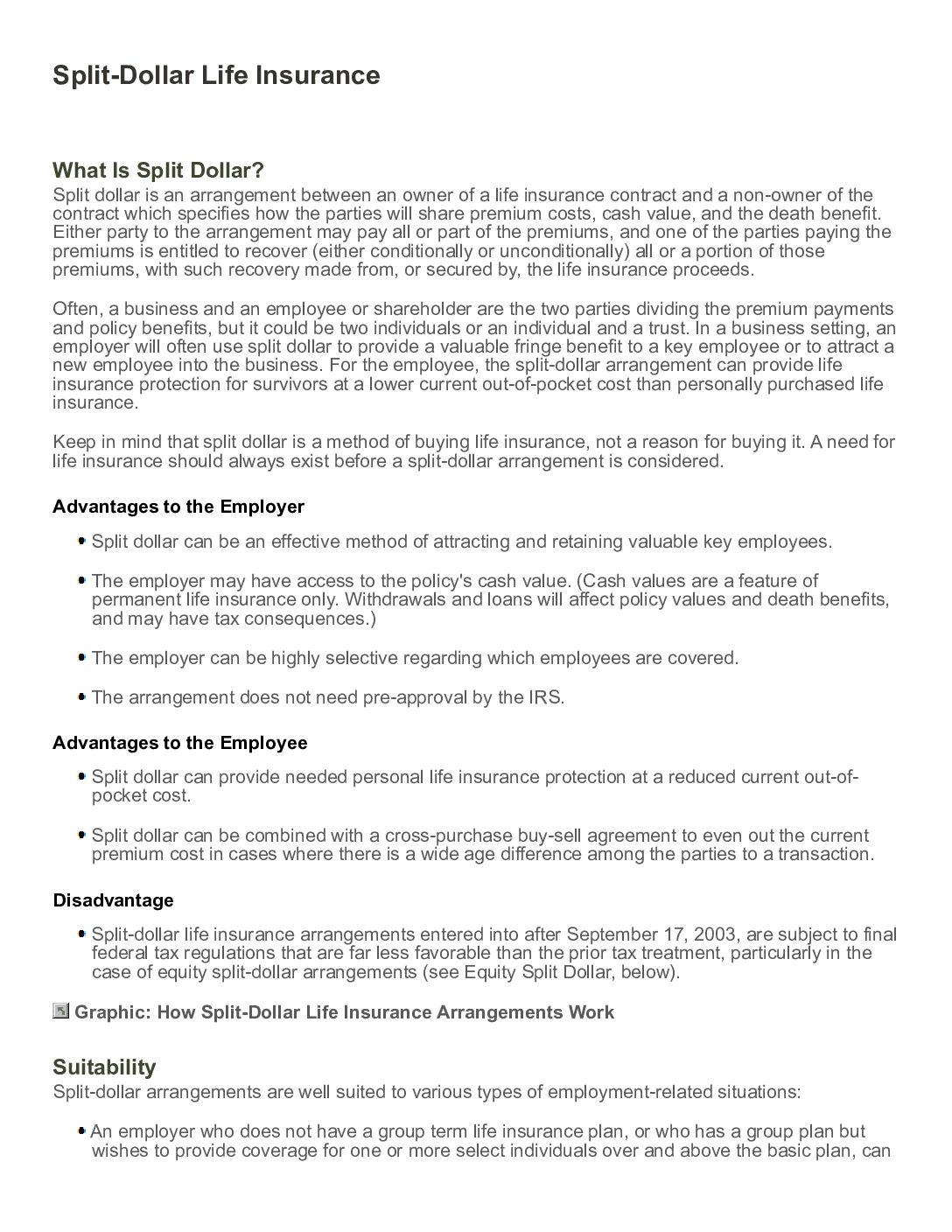
A wide variety of split-dollar plans exist today. All involve two or more people or entities splitting the costs and benefits of some sort of permanent life insurance. It’s a simple concept that helps an individual buy life insurance at an affordable cost.
There are two split-dollar methods:
- Collateral Assignment: Employee-owned policy that assigns policy benefits as collateral for the employer’s premium advances.
- Endorsement: Employer-owned policy with an agreement on the employee’s rights.
Taxation generally depends on which method is used.
For either method, if the employer’s share of cash value is limited to net premiums paid while the employee has access to the policy’s remaining cash value, it is an equity arrangement. If the employee has no interest in the policy’s cash value, it is a nonequity arrangement.
 Executive Compensation Split Dollar Arrangements Funded with Life Insurance
This guide breaks down each split-dollar method and provides an in-depth look at each, including tax implications, transfer of ownership and much more.
Collateral Assignment Split Dollar Life Insurance Plans
Loan Regime Split Dollar Arrangement
If the executive or individual owns the life insurance policy, any money the employer pays toward the policy is seen as a loan on which the owner must pay interest.
A collateral assignment on the life insurance policy is used to provide collateral on the loan. This prohibits the employee from accessing cash values and assigns death benefit up to the amount owed to the employer, with any remaining amount going to the employee’s beneficiaries. Upon repayment of the outstanding loan, the collateral assignment of the policy death benefit and values are released, leaving the employee with full control over the policy death benefit and any remaining cash value.
Executive Advantage is a loan regime split dollar arrangement through North American that can offer a number of benefits for both the employer and the employee.
| For the Employer: | For the Employee: |
|
|
| Potential costs to the employer may include: | Potential costs to the employee may include: |
|
|
Endorsement Split Dollar Life Insurance Plans
Economic Benefit Regime Arrangement
If the employer owns the policy, any money it puts into the policy is considered a taxable economic benefit for the executive. That means they’ll have to pay taxes on the value of the insurance and its cash value.
Upon the death or retirement of the employee, the employer receives its interest in the policy. This interest is often an amount equal to the amount of premiums the employer paid. Any remaining death benefit is paid to the employee’s beneficiary. Or upon retirement, the policy may be transferred to the employee along with any remaining cash value.
A split dollar plan can offer a number of benefits for both the employer and the employee.
| For the Employer: | For the Employee: |
|
|
| Potential costs to the employer may include: | Potential costs to the employee may include: |
|
|
1. Policy loans from life insurance policies generally are not subject to income tax, provided the contract is not a Modified Endowment Contract (MEC), as defined by Section 7702A of the Internal Revenue Code. A policy loan or withdrawal from a life insurance policy that is a MEC is taxable upon receipt to the extent cash value of the contract exceeds premium paid. Distributions from MECs are subject to federal income tax to the extent of the gain in the policy and taxable distributions are subject to a 10% additional tax prior to age 59½, with certain exceptions. Policy loans and withdrawals will reduce cash value and death benefit. Policy loans are subject to interest charges. You are urged to consult with an attorney or tax advisor who can provide appropriate advice that meets your particular needs and circumstances.
Consumer Marketing Materials




Dedicated Team
2026 fmiAgent Point Awards
You must be logged in to use this feature.